
Defending Unionism
Worker organizations as a key egalitarian institution

Over the past months I’ve seen many criticisms of unionism in left liberal spaces that I believe don’t apply well to leftists or aren’t very powerful when considered in context. The standard argument goes that unions cause unemployment, reduced investment, and inefficiencies that overall harm the competitiveness of our economies. Anti union liberals now point to a relatively new literature of regression discontinuity and right-to-work research as the empirical basis for their arguments. In this article I’m going to defend unionism on the basis that
1) It’s likely that the RTW(right-to-work) and RDD(regression discontinuity design) can’t key in on important mechanisms which when considered cast unions in a much less negative light.
2) We have very strong theoretical and empirical reasons to believe that the RTW and RDD research doesn’t apply well to the types of unionism leftists and egalitarians actually desire.
3) In the correct institutional context unions can and have been economically and socially desirable as the primary building blocks of a productive egalitarian society.
The new union literature
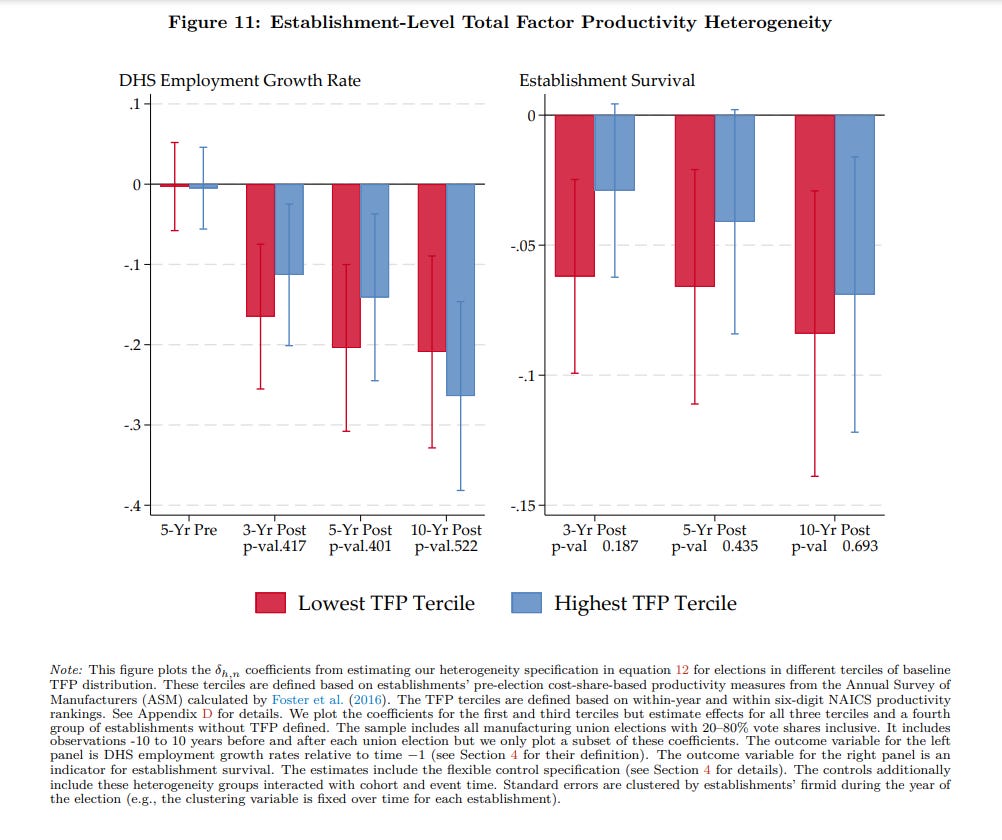
Large portions of the established research on unions is plagued with causal inference issues, because unionism at the establishment level is endogenous and causally linked to various negative factors it’s hard to establish much of anything from standard regression analysis. To mitigate this issue you can either look for a treatment that exogenously shifts union power like right-to-work, or you can look at firms with close union elections as a fairer comparison which would be a regression discontinuity analysis. The RDD research consists of studies like Bradley et al.(2015), Kini et al.(2022) and Lee & Mas(2012), the RTW research consists of studies like Austin & Lilley(2021). Their results imply that unions reduce innovation, employment, product quality and investment among other things that if true would be a massive blow for unionists. We first have to question the factors that drive many of these findings, anti union liberals will argue that they’re the result of real union costs but an equally plausible causal story is that these findings track an ideological opposition to unions by employers. Survey data in Freedman(1979) & Foulkes(1980) document a philosophical opposition to unions by management especially in less unionized firms and Wang & Young(2022) observe many irregularities in the data that fit the production shifting hypothesis more than the union cost hypothesis. They don’t find significant differences in survival effects of unions in establishments with different productivities, which wouldn’t match the firm dynamics needed for the productivity or wage explanations to hold. Incidentally the authors note that new research doesn’t find evidence of new unionization leading to drastic changes in wage costs or productivity. This alternative explanation could also partially explain the heterogeneous union effects we observe between countries given that establishment level unionism more easily allows for production shifting compared to firm/business or sector level bargaining.
One could argue that production shifting, even when not productivity or wage caused, is still a negative effect of unions, but if the negative effect of unions is in large part explained by the fact that employers are anti union independent of productivity or wage concerns, then the argument becomes very odd. If I threaten to commit acts of unexplained violence in response to people wearing red shirts, something that’s obviously a bad outcome, it seems strange to use my threat as a blame placing argument on the part of people who wear red shirts. In that situation it seems obvious that the “bad” or “injustice” is coming from me who is sending out unwarranted threats rather than people who’d chose to wear red. These findings generally still count as good evidence of a negative effect of unions on the economy, but hopefully my argument casts some doubt on the narrative that this negative effect is wholly driven by bad choices on the part of unions.
Do the institutions matter?
One key limitation of the RDD and RTW literature is that all of them are based in the US, a country with very uncoordinated decentralized bargaining, which could explain some negative findings. If we want to argue that this literature doesn’t apply to the types of unionism leftists care about we have to present good theoretical reasons for why we’d expect different outcomes aside from just being in the wrong country. We can analyze different systems of collective bargaining by vertical integration( the degree of centralization) and horizontal integration(the degree of coordination). The important theoretical difference for us is the degree of horizontal integration because horizontal integration a priori relevantly changes the way unions bargain at the firm level. Unions in the Nordics and much of continental Europe have robust systems of inter-establishment/company integration not present in the US, these are large broad solidaristic organizations operating very differently from insider-outsider unions. When unions have to cooperate and coordinate as a matter of economic or social convention, we’d expect firm level unions to internalize the negative externalities of their bargaining in ways they wouldn’t at the establishment level. A great illustrative example is unemployment, insider outsider models of unionism predict that by increasing the price of labor irresponsibly unions reduce the demand for labor and increase unemployment, but this shouldn’t hold for coordinated unions. Unions individually might not consider wage restraint, but it’s clear that unions collectively have a strong interest in keeping unemployment low for economic and political reasons. Micheal Kalecki in his article “Political Aspects of Full Employment” explains that under tighter labor markets labor becomes scarcer for businesses which leads to an increase in bargaining power for labor and labor organizations. Coordination resolves this tension by creating an environment where each union bargains with shared interests like this in mind, countering the tendency for unions to behave shortsightedly. Employment is just one piece of the puzzle, but we can imagine various ways this type of externality management can relevantly alter the effects of bargaining. This externality management mechanism provides a strong theoretical basis for leftists to reject extrapolations from US research to other forms of unionism, but it’s still important that the observed effects of unions is also heterogenous along these lines.
Exploiting changes in union membership subsidization creating exogenous shifts in union membership/density in Norway, Barth et al.(2020) study the effects of unionization on productivity and wages. Using a comprehensive data set they observe that an increase in union density induced by the subsidies increased firm level productivity and wages, with the more significant effects presenting themselves past a threshold which makes sense if we consider the threshold the point where an agreement is made.
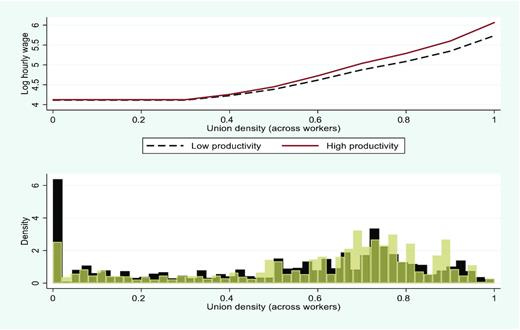
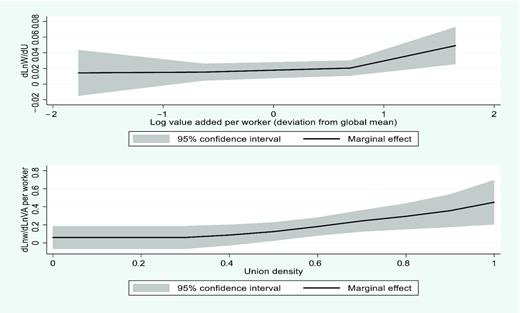
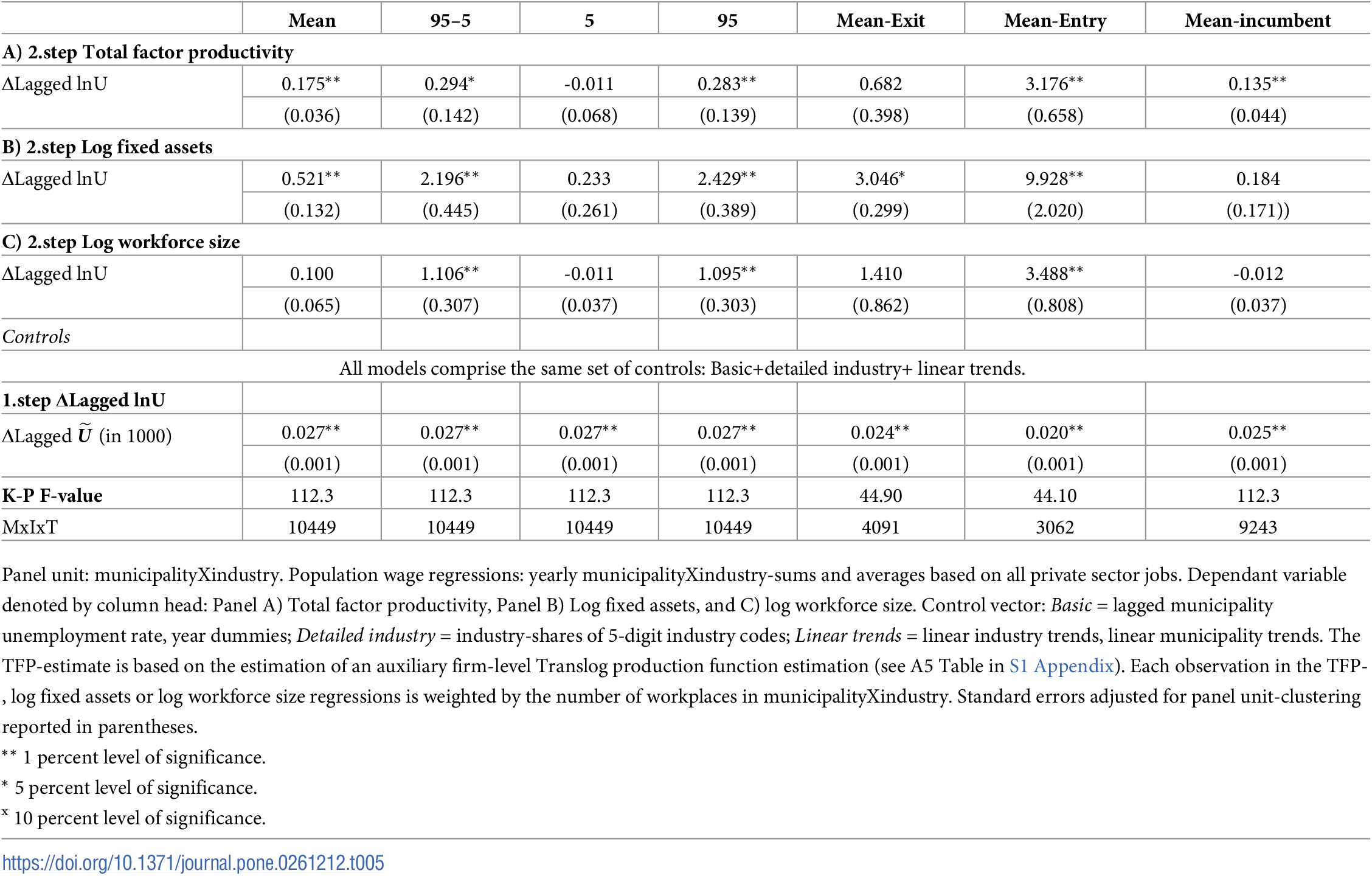
Dale-Olsen (2021) uses Norwegian regional data to supplement the findings of Barth et al, he finds that local unionization is associated with wage and productivity growth through creative destruction. Unions created wage increases because they caused productivity laggards(unproductive firms) to close which frees up resources for more productive firms, interestingly they also find that unionization is associated with reduced entry into unemployment programs which implies that there’s minimal harm to workers in those less productive firms. More interesting still is the observation that increased unionization doesn’t reduce entry or job creation and that it increases the productivity of those new entry firms. These findings stand in contrast to what we observe in Canada and the US, where the productivity-union effect is relatively small to non-existent. The fact that unions reduce inflow to unemployment programs as a result of their creative destruction also provides evidence for our externality mitigation hypothesis for coordinated bargaining.
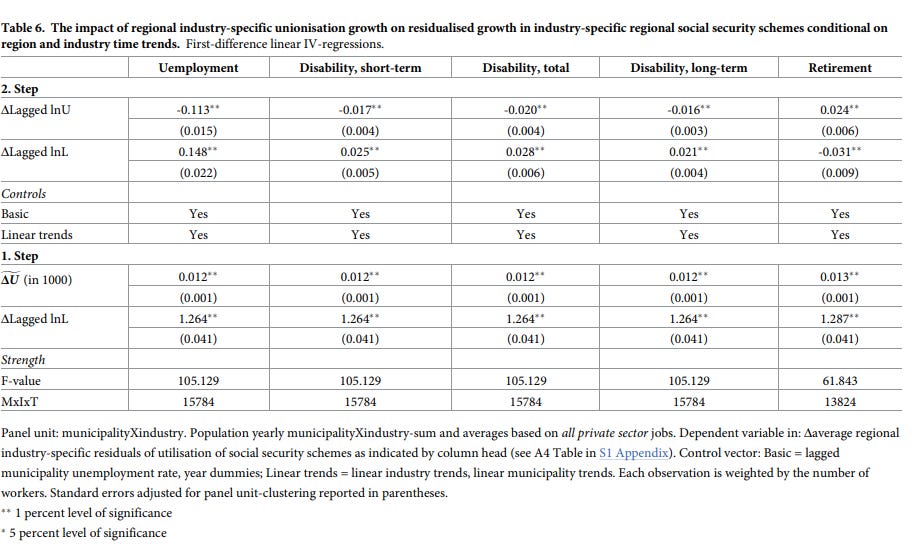
Some people contest the usefulness of studying multilevel bargaining systems because there isn’t a proper control of non union influenced firms as every firm is covered by some sort of agreement, but there’s no reason to not treat those agreements the same way we treat wage and condition floors in Anglo countries. We wouldn’t, for example, object to union research in America because there isn’t a control group of firms not subject to any labor market regulation, so I don’t see why that would change when the broad regulation is done by labor organizations instead of the government. At the very least these findings undermine the idea that the US literature can be properly applied to the systems of collective bargaining leftists actually want, which makes presenting them in those arguments not powerful.
Social and political benefits
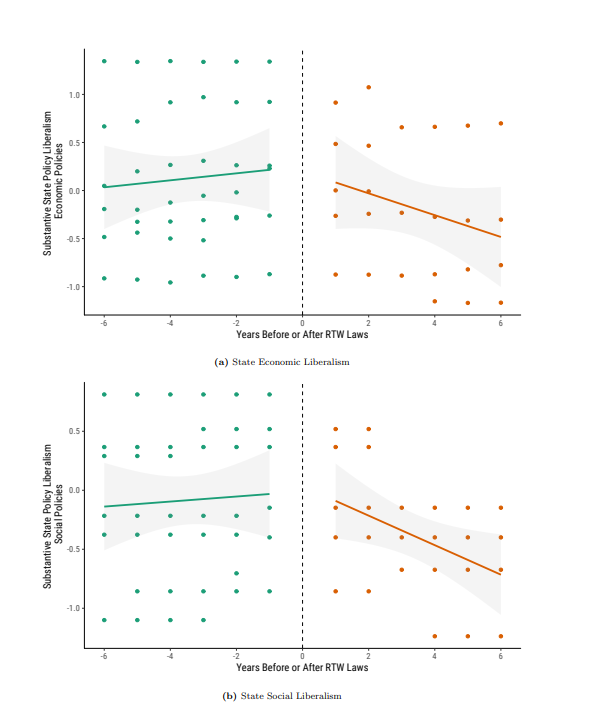
It’s pretty commonly accepted in political sciences that unions and worker organizations are key components in building a solidaristic welfare state, behind this belief are a few key theoretical arguments. Unions historically have helped build political solidarity between different groups of workers that don’t typically interact through their coordination and shared pro labor political initiatives. We’d also expect equalizing incomes to lead to more solidarity because as inequalities between workers reduce, so too will the lifestyle differences between them that would lead to social divisions. By creating an egalitarian ethos and building organizations that participate in organizing, lobbying, and activism, unions are a key part in passing left wing policy. These mechanisms are going to be mediated by the levels of horizontal and vertical integration between the unions because we’d expect more coordinated and centralized systems to create less inequality and build more cooperative opportunities. Even if you find these theoretical arguments compelling enough to endorse coordinated unionism on sociopolitical grounds it’s still important that our theoretical expectations properly fit the available evidence. Unions typically lobby the government against policies that reduce their power as organizations and for policies that increase the bargaining power of workers as a class, for things like unemployment insurance and against things like right-to-work. Unions financially contribute to and mobilize workers to vote for left wing parties which obviously increases the likelihood of left wing policy being passed, Feigenbaum et al.(2018) for example find that right-to-work laws reduce democratic party vote share by reducing union influence. They also find that right-to-work laws skew the demographics of our elected officials towards the wealthy and shift economic and social policy to the right.
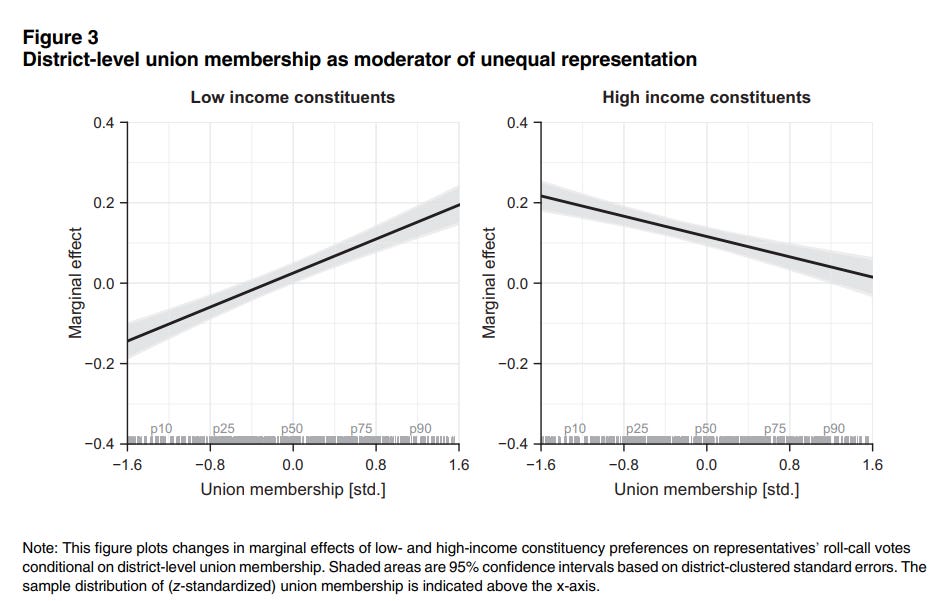
Becher & Stegmueller(2020) supplement their findings by presenting evidence that unions increase the sensitivity of our democracy towards the preferences of the poor.
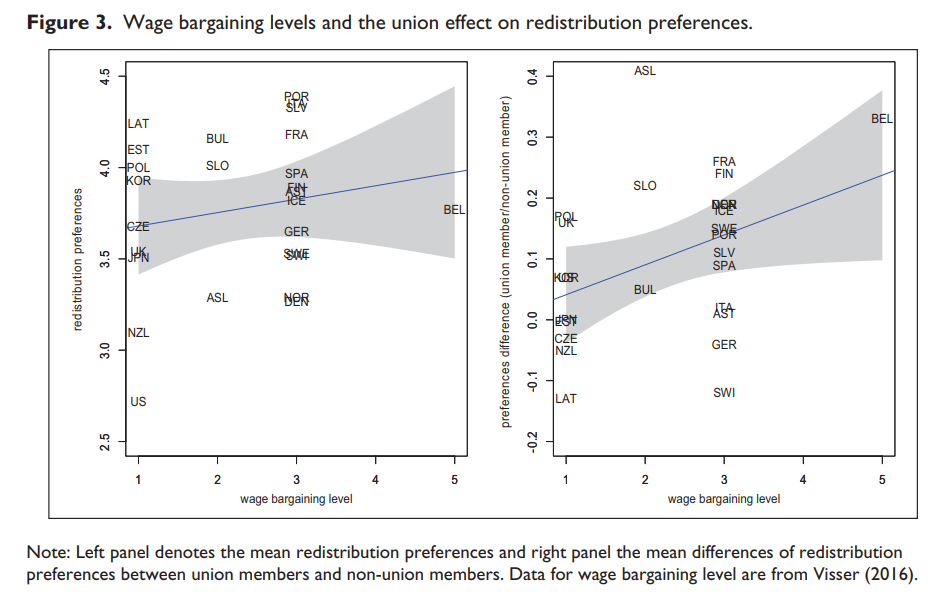
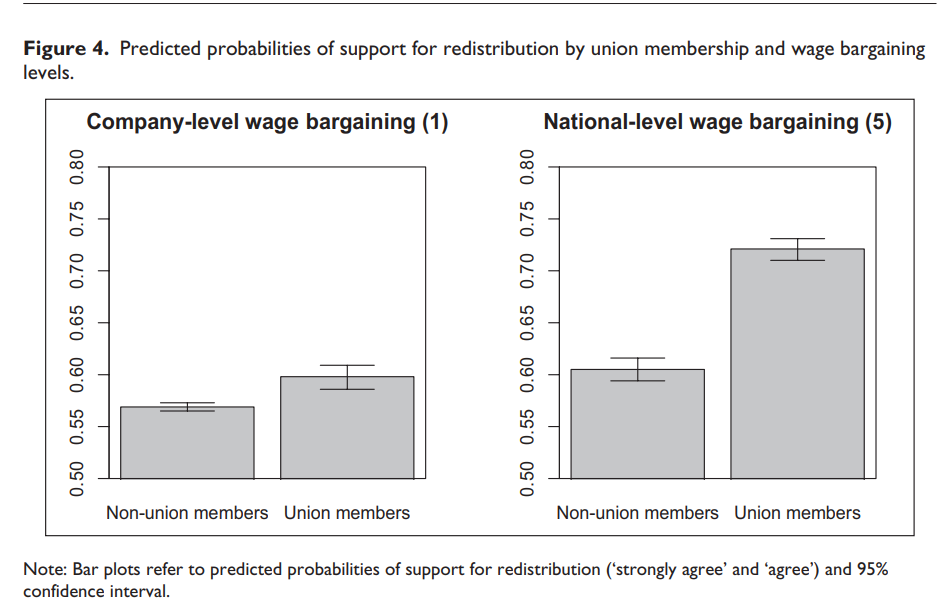
Multi level unionism creates an environment where workers of different backgrounds have to cooperate which we’d expect to build solidarity and support for the welfare state, Yang & Kwon(2019) find evidence that union members are more egalitarian than non union members and that higher level bargaining strengthens the egalitarian ethos.
Beyond their impacts on the economic views of their members, unions also seem to cause desirable shifts in the social views of their members. Frymer & Grumbach(2020) apply cross sectional analysis on national survey data and find that union membership is associated with less racial resentment and tension.
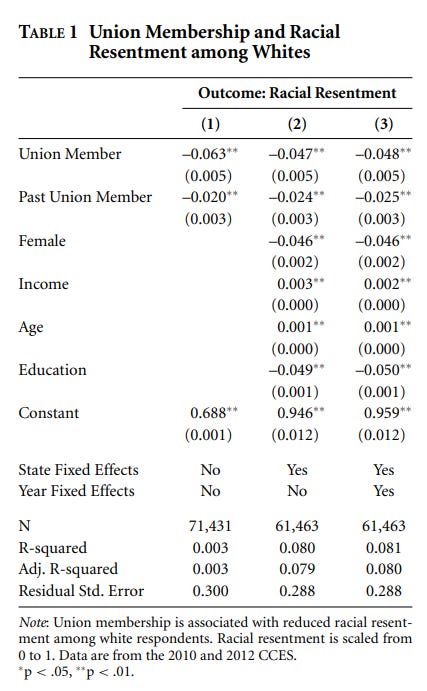
I encourage readers to independently take a look at all the research I’ve cited because I believe that taken together they paint an overwhelmingly positive picture on the social effects of unions for left wing political action. These results also match our hypothesis on the effects of union membership on solidarity, with the solidarity effect increasing as a function of centralization of collective bargaining.
The bigger picture
Why does all of this matter? Well we’re living through a period of increasing economic inequality which in itself seems to not increase support for redistribution, Sànchez et al.(2018) supports the notion that systems of inequality tend to reinforce themselves through a sort of acclimatization process. The empirical support for real increases in inequality tracking support for redistribution is very sparse, our best survey data tracks no relationship Stancheva(2021). These facts make it clear to me that the existence of more and more inequality by itself isn’t actually going to reduce inequality, contrary to what’s expected under standard theories of political dynamics. MacDonald(2019) finds that union membership actually channels increased inequality into support for redistribution, to me this indicates that people need an institution to inform them politically, and turn their feelings into actionable policy. Broad based unions matter because they’re probably the only interest group out there that is able to have significant power and use it for egalitarian ends, other institutions are dominated by the wealthy or a smaller subset of the workforce with splintered less representative interests. In light of these considerations I believe that anti union left wingers should take seriously the key role unions have in building an egalitarian society. The benefits of broad based unionism can’t be captured if unions in America and Canada stay divided like they currently are, it’s on us to create a culture of collective bargaining that’s built on cooperation and solidarity for a fairer and better world.